Estrogen and collagen are connected, but not by a simple “more estrogen = stronger fascia” formula. Evidence looks different in skin, bone and the cornea — and direct research on menopause-related changes in fascia itself remains limited.
A tissue-by-tissue map
Hydroxyproline: a pathway, not a single outcome
During collagen production, enzymes convert selected proline residues into hydroxyproline, which helps stabilise collagen’s structure. Estrogen is not known to directly trigger that chemical conversion. The source paper describes a broader maintenance role involving matrix turnover and reduced breakdown.
Dermal collagen / tissue-bound Hyp
Brincat et al., 1983, 1987
Resorption markers / urinary Hyp
Cosman et al., 1993; Vural et al., 2006
Local matrix remodelling in models
Zhang et al., 2026
What does that mean for women’s fascia?
It is a thoughtful starting point, not a diagnostic shortcut. Skin studies cannot establish what happens to a woman’s fascial glide, load tolerance or movement experience. Bone markers are not a body-wide collagen score. And a response observed in corneal models cannot be generalised to the whole body.
For women interested in movement and tissue health, the practical lesson is to stay curious about the biology without reducing every midlife change to estrogen alone. Ageing, loading, health conditions, medications, sleep and individual history also shape tissue behaviour.
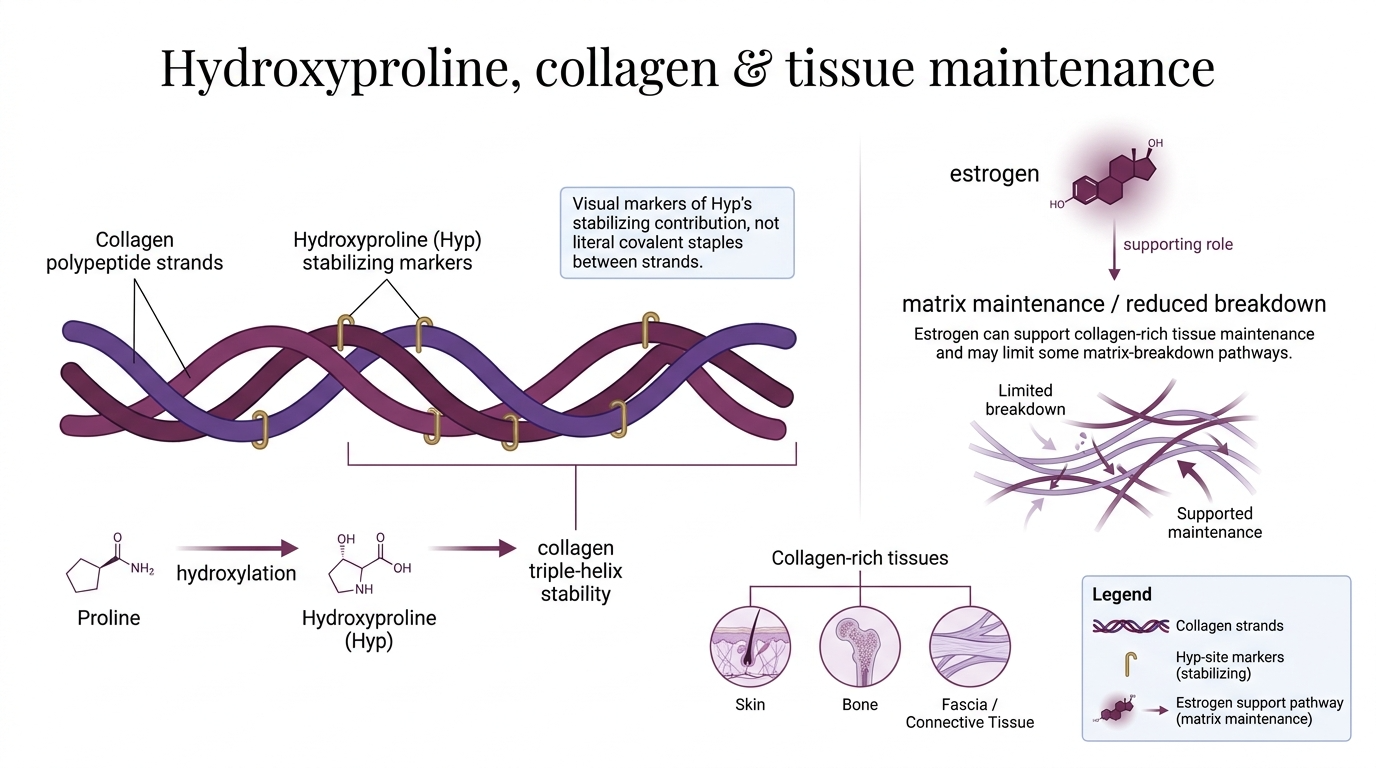
Hydroxyproline: A Molecular Stabiliser of Collagen. Estrogen supports tissue maintenance and influence some matrix-breakdown pathways. Original image generated with Figurelabs.ai
A careful note on hormone therapy
The studies reviewed here are not a prescription for HRT and do not show that HRT should be used to improve fascia or skin appearance. Current UK guidance recommends an individual conversation about benefits, risks, symptoms and medical history. NICE advises using the lowest effective dose for people who choose HRT. See the NICE menopause recommendations and the NHS overview of HRT benefits and risks.
References
Brincat et al. (1983), BMJ; Brincat et al. (1987), Maturitas; Cosman et al. (1993), Annals of Internal Medicine; Goulding et al. (1996), Journal of Bone and Mineral Research; Seibel et al. (1993), Journal of Bone and Mineral Research; Vural et al. (2006), Pharmacological Research; Zhang et al. (2026), Investigative Ophthalmology & Visual Science.
YOUR FREE GLIDE GUIDE
Stiffer, puffier or simply less at ease in your body lately? Discover how oestrogen, progesterone, relaxin and cortisol shape the way your fascia feels, and how to move with your hormones, not against them.
Author