THE SPIRAL REVIEW · FRIDAY GLIDE DAY
You get up after a long sit. The first few steps feel stiff, then walking feels easier. It’s a small moment, but it raises a question I keep coming back to in my fascia research: what gives?
What helps neighbouring tissues move past one another, and how do they recover after a load?
Picture a damp, loosely woven cloth. Give it a gentle tug and the threads shift while the weave stays connected. That’s how I invite you to picture fascia: a continuous weave with fascial planes where neighbouring regions can glide relative to one another. The cloth helps us picture continuity. In the body, the weave is alive, and its cells can change the hydrated environment around them.
I call this viscoelastic hydration buffering. A hydrated matrix can deform under pressure and recover over time. Hyaluronan, or HA, helps shape that environment by interacting with water. Cells can make HA, retain it, break its chains into shorter pieces and clear it. I want to know how those processes help the fascial planes recover their capacity to glide after loading.
What tells the tissue to turn the dial down?
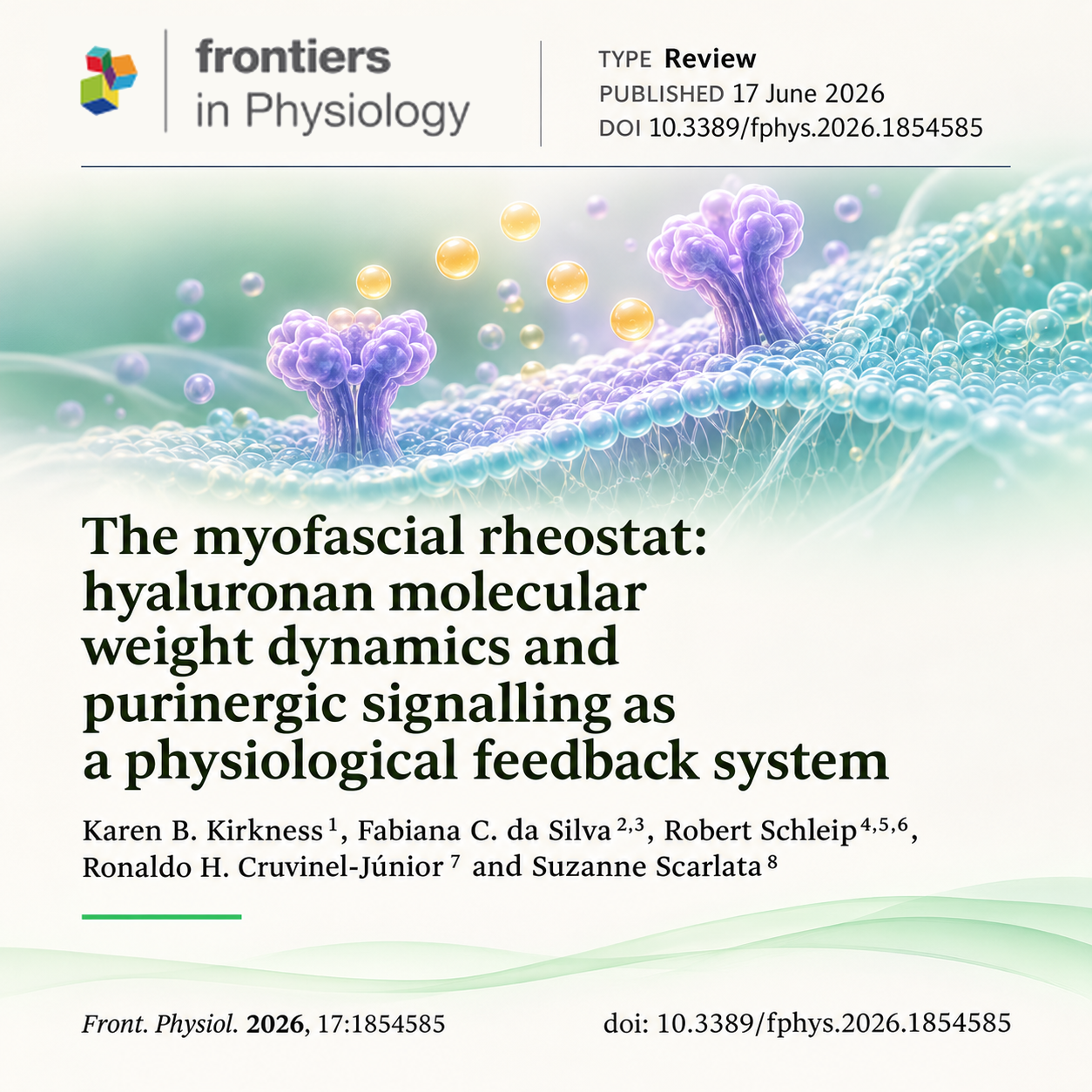
In one lab experiment, skin cells responded to ATP outside the cell by briefly making more HA. Calcium carried part of the signal inside the cell. When the researchers added AMP or adenosine, both products of ATP breakdown, HA production fell. This is one reason I’m interested in the moment after a tissue responds. What brings that response back down? The experiment measured HA production in skin cells. It leaves open whether fascia uses the same sequence after a load. Read the skin-cell experiment
Another team measured friction at the interface where a tendon glides within its sheath. An applied combination of HA and lipids reduced friction more than either component alone in their setup. The experiment shows why the local environment matters for gliding. How living tissues restore that environment after loading is still an open question. Read the tendon-friction experiment
What to take into your week
- Notice when stiffness changes. Pick a familiar movement, such as your first few steps after sitting. Notice how it feels at first, after a few minutes, and later that day. If you’re keeping notes, include what you did beforehand. You’re tracking a pattern in how you feel.
- Ask what was measured. If a claim says a class, treatment or product “improves fascia glide,” look for the outcome. Feeling freer, measuring lower friction, and measuring a change in HA are three different things.
For those of us in midlife, the next question is whether changing estradiol affects HA turnover in tissues that bear load, and whether researchers can connect that to stiffness or glide. These experiments give us ways to ask the question. They leave the role of the menopause transition open. Explore my fascia research at Spiral Syllabus
YOUR FREE GLIDE GUIDE
Stiffer, puffier or simply less at ease in your body lately? Discover how oestrogen, progesterone, relaxin and cortisol shape the way your fascia feels, and how to move with your hormones, not against them.